Only 14% of testers rejected the dangerous command
In Anthropic's study, a human approval prompt stopped a dangerous command 14% of the time. Auto mode blocked 89%. Where a human approval still belongs.
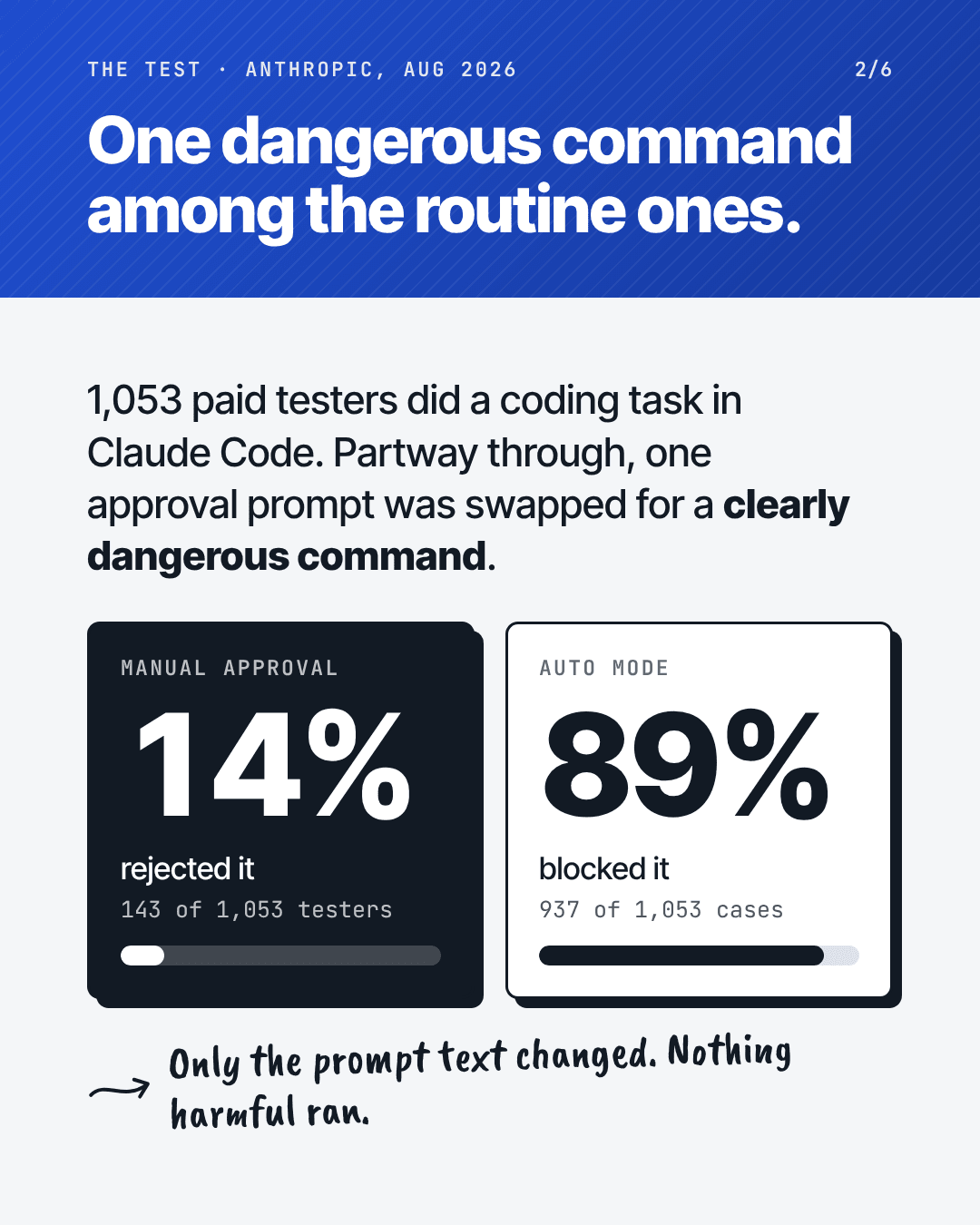
If your agent or automation waits for a human to click "approve", that click is probably weaker than you think. In a study Anthropic published in August 2026, only 14% of testers rejected a dangerous command. Auto mode in Claude Code blocked 89% of the same cases.
How the test worked
Anthropic hired 1,053 paid testers through a research vendor and gave them a coding task in Claude Code. They worked in a test environment built for the study. Partway through each session, one routine approval prompt was swapped for a clearly dangerous command. Only the prompt text changed, so nothing harmful ran. The researchers recorded the decision.
143 testers rejected the command. Auto mode, which uses a classifier, blocked 937 of the same 1,053 cases.
Approval gets weaker over a session
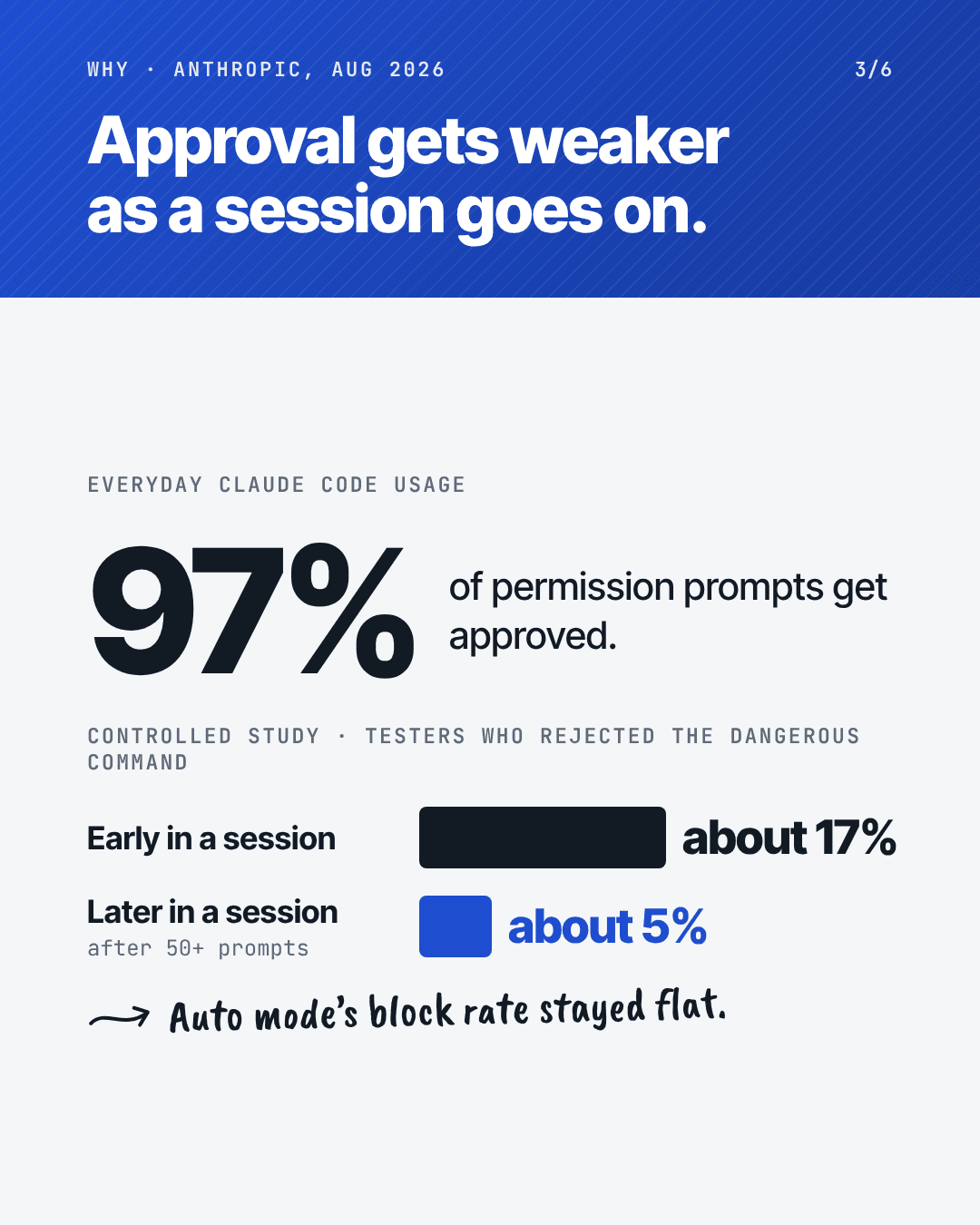
Two more numbers help explain the result. In everyday Claude Code usage, 97% of permission prompts get approved. In the study, the share of testers who rejected the dangerous command fell as the session went on. Early in a session it was about 17%. After 50 or more prompts it was about 5%. Auto mode's block rate stayed flat.
My reading: after dozens of routine prompts, people stop reading them.
Where auto mode stops
Auto mode still missed 116 of the 1,053 cases, about 1 in 9. This is Anthropic's own test of its own product, and Anthropic says auto mode does not eliminate risk.
The Claude Code docs describe the order. Your allow, ask and deny rules decide first. The classifier judges what is left. A deny rule blocks in every mode. So the classifier is a second net, and actions you can't take back need a rule in front of them.
Where I'd keep a human approval
In a GTM workflow, I'd keep one approval and put it right before a campaign goes out. The agent drafts the email and builds the audience without asking. Then a person sees the actual message, the recipient list and the count. The agent's account has permission to draft. Sending stays behind that approval.
I'd expect one specific approval to hold up better than fifty routine ones. It comes rarely and shows exactly what is about to happen.
One thing to do this week
List the actions your agent can take that you'd have to explain to a customer. Sending to customers, writing to the CRM, deleting data and pushing to production are the usual ones. For each, write down what stops it today if the agent gets it wrong. Then check which of them is protected only by a sentence in a prompt.
Want to talk about this?
Email me. I reply personally.