Block Blast deals an impossible hand when your next ad pays 3.5x
A teardown of the rules Block Blast runs on each install, and the line between experimentation and manipulation.
For growth engineers who run experiments on users: a teardown, and a line.
What the server decides
Ayo Omolewa decompiled Block Blast (October 2026) and documented what the server decides. Each install gets assigned "traits": his Android copy listed about 700 in its config, selected 254 and downloaded 101 after install as encrypted JavaScript. These rules choose your pieces, your score boosts and your ads, and they change without an app update.
The lethal puzzle
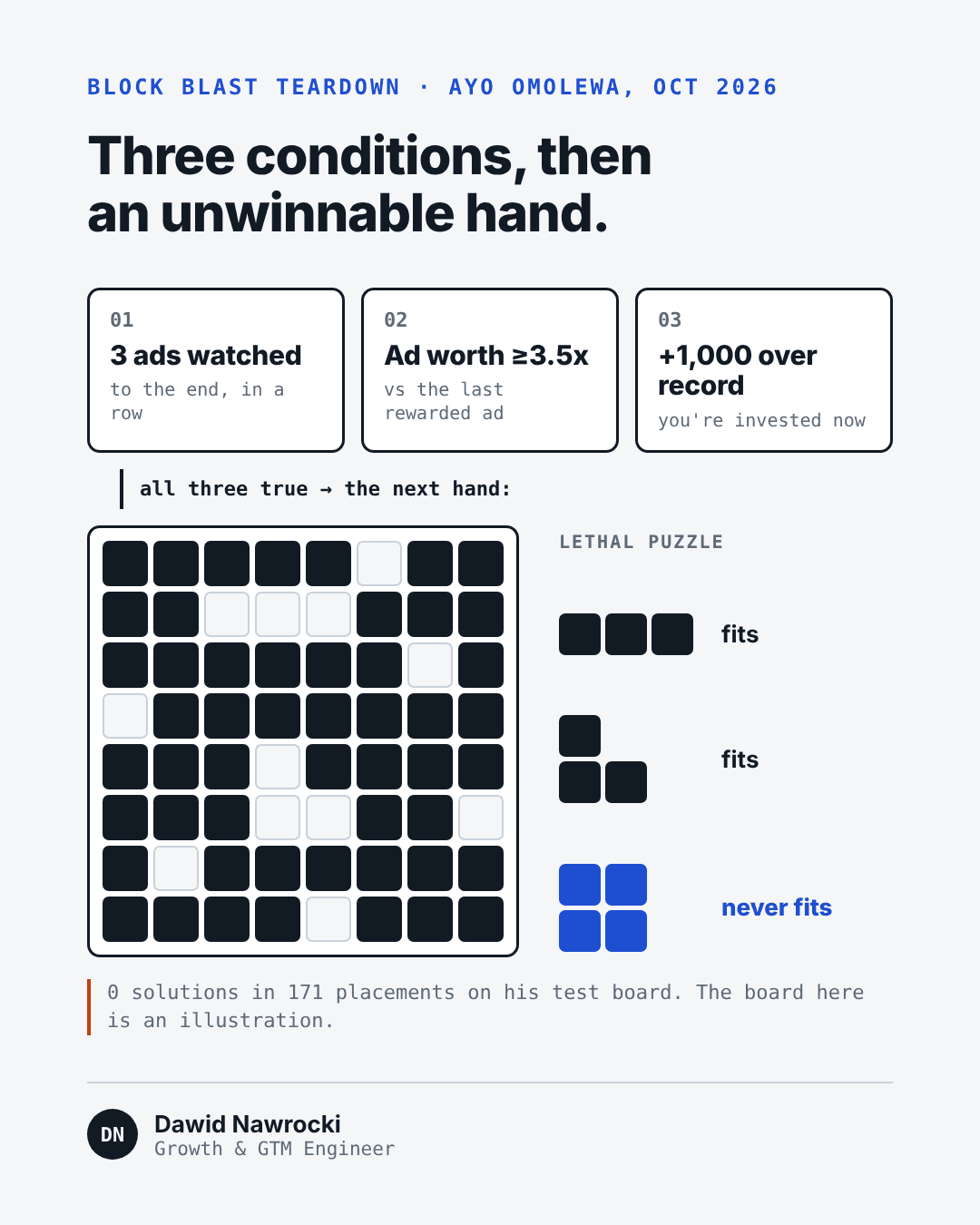
One trait stands out. If you watched your last three rewarded ads to the end, the loaded ad is worth at least 3.5x the last one, and you're 1,000 points past your high score, the next deal is a "lethal puzzle": two of the three pieces fit, so the hand looks playable until you try it. On his test board, a brute-force search found zero solutions across 171 placements.
The ad price comes from an XGBoost model with 27 inputs, including country, phone model and RAM. In his sample, a new US player on an iPhone was worth 25.48 per thousand ads, the same player in India 5.59.
Impressive as infrastructure
As infrastructure, it's impressive: per-install remote config, multi-arm experiments, a pricing model shipped to the device and evaluated in real time. Many B2B SaaS teams can't change onboarding without a release.
Manipulation as a decision
As a decision, it's where experimentation turns into manipulation. The rule earns ad revenue by making players fail at the moment they're most invested.
The test I'd apply
The test I'd apply to any experiment: would it still be acceptable if the user could read the config? The onboarding tests behind an 18% signup lift at Appsmith pass it easily. An unwinnable hand dealt to the players most likely to watch an ad doesn't.
How far the findings go
One emulator install, one simulator and a made-up player for the pricing numbers, so treat the specifics as one researcher's findings. Full breakdown by Ayo Omolewa.
Where do you draw the line in your own experiments?
Want to talk about this?
Email me. I reply personally.